

1. RSI in Canada and Quebec: A Mandatory but Incomplete Reference
In Quebec and Canada, thermal resistance RSI—or its imperial equivalent, the R-value—remains the standard regulatory indicator. It is used in the Quebec Building Code, the CNÉB 2020, and programs such as Novoclimat and Rénoclimat. However, RSI primarily measures conduction, i.e., the transfer of heat through the thickness of the material.
This approach works very well for thick insulation materials: mineral wool, polyurethane, cellulose, or rigid panels. It becomes more limited when evaluating a thin-coat insulation coating applied like paint in a few millimeters. Even with good thermal conductivity, its thickness remains low; its RSI value will therefore naturally be low.
| Component | Montreal (< 6,000 DJC) | Quebec / Saguenay (≥ 6,000 DJC) | Measurement standard |
|---|---|---|---|
| Roof / Ceiling | RSI 5.46 (R-31) | RSI 6.17 (R-35) | ASTM C518/C177 |
| Above-ground wall | RSI 3.60 (R-20.4) | RSI 4.05 (R-23) | ASTM C518/C177 |
| Foundation wall | RSI 2.99–4.31 | RSI 5.11 | ASTM C518/C177 |
| Source: CCQ Chap. I.1 (2020), RBQ, Novoclimat 2.0. | |||
Liquid thermal insulation coatings containing hollow microspheres, applied in a layer of 0.5 to 3 mm, achieve an RSI ≈ 0.03—a negligible value compared to CCQ requirements. But this comparison is a physical fallacy: these products primarily function through solar reflectance and infrared emissivity, two mechanisms that RSI = e / λ completely ignores.
RSI = e / λ measures only conduction. Comparing an RSI of 0.03 to the R-31 required for a roof is like comparing half a performance to a full performance.
2. The Three Modes of Heat Transfer
The physics of heat transfer is based on three distinct mechanisms. RSI formally measures only one of them.
Conduction — what RSI measures
Energy transfer through a material without macroscopic motion. The dominant mechanism in thick insulation (rock wool, spray polyurethane, blown-in cellulose). RSI = e / λ. Most relevant during Quebec winters.
Convection — surface resistances Rsi / Rse
Heat exchange at wall–air interfaces. For a vertical wall: Rsi = 0.12 m²·K/W + Rse = 0.04 m²·K/W (ASHRAE/ISO 6946). Independent of thin-layer cladding.
Radiation — invisible to RSI, decisive for thin layers
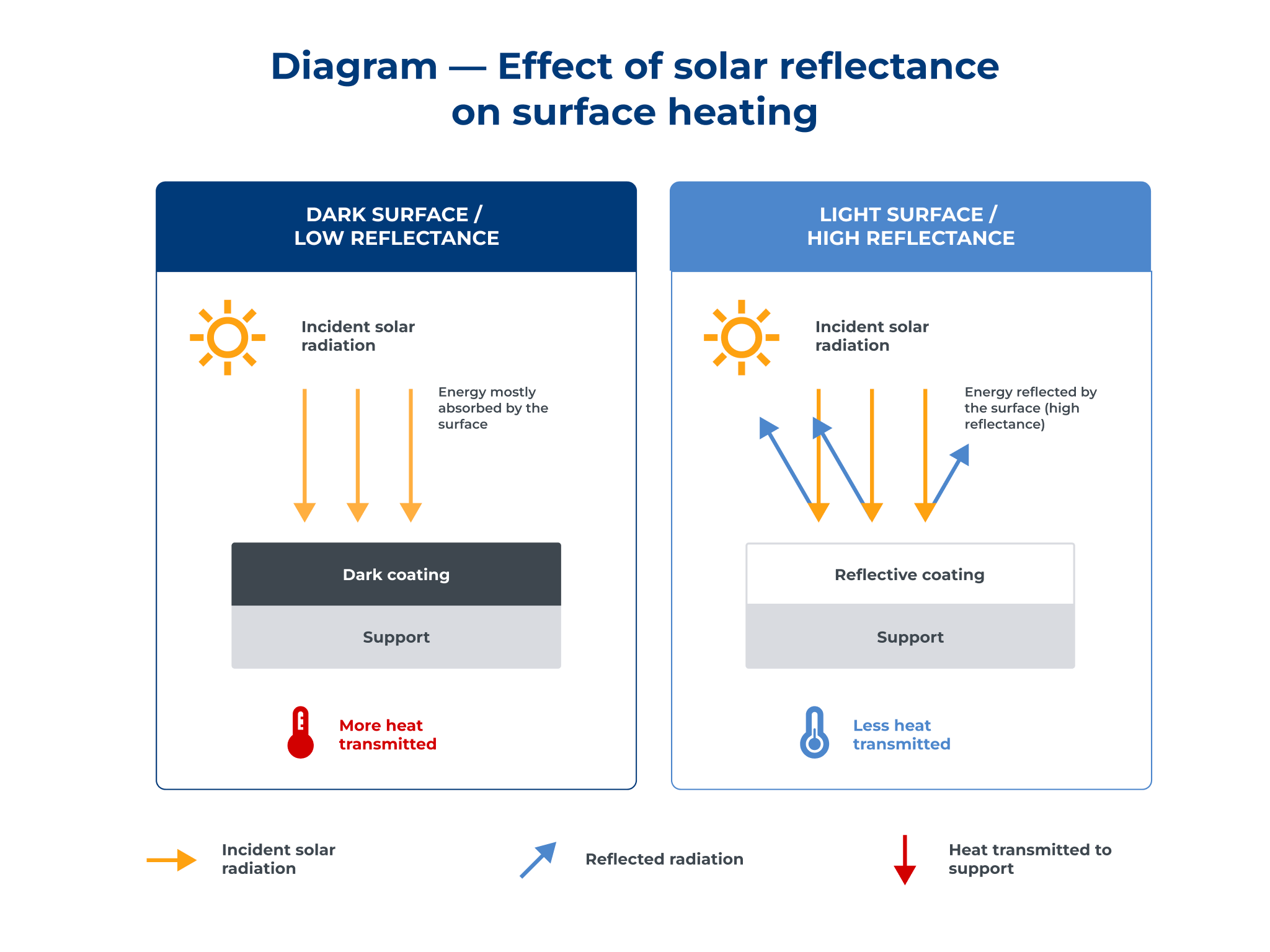
- Solar radiation (0.3–2.5 µm): a dark roof reaches 70–80 °C in Montreal in summer; a reflective coating keeps it at 30–40 °C. Reducing the load at the source is thermodynamically more efficient than adding insulation to an already hot wall.
- IR thermal radiation (8–14 µm): every surface emits heat according to its emissivity ε. In a Quebec winter, 25 to 35% of heat loss from a poorly insulated building occurs via radiation—a mechanism not captured by the RSI.
In winter in Montreal, approximately 25 to 35% of heat loss from a poorly insulated building occurs through radiation, not conduction. RSI does not measure these losses. A low-emissivity interior surface coating specifically addresses this component.
3. Reflectance and Emissivity: Definitions and Measurements
Solar reflectance (SR / albedo) — ASTM E903
The fraction of solar radiation reflected without absorption. Black asphalt: SR ≈ 0.05. Optimized microsphere coating: SR ≈ 0.85–0.92. Measured air conditioning savings: 35 to 55% for Montreal (Čekon et al., Energy and Buildings, 2014). In winter, the opposite effect (slight increase in heating requirements) remains modest in Quebec given the low angle of solar incidence.
Thermal emissivity (ε) — ASTM C1371
The ability of a surface to re-emit infrared energy. Concrete/brick/latex: ε ≈ 0.88–0.93. A coating with ε = 0.10 on an interior surface reduces winter radiative losses by 80%—without altering the wall’s RSI in the slightest. In summer, high external emissivity promotes passive nocturnal radiative cooling.
SRI Index — ASTM E1980
A composite indicator combining SR + ε. Scale 0 (black) to 100+ (highly reflective). Not required by the CCQ/CNÉB 2020 for opaque surfaces in general but recognized in LEED certifications and Canadian institutional specifications.
A coating with an emissivity of ε = 0.10 on the interior surface of a poorly insulated wall can reduce radiative heat loss by 80% compared to standard paint (ε = 0.90). This performance is not reflected in the wall’s RSI value.
4. Comparative Table of Indicators
| Criterion | RSI / R-factor | Reflectance (SR) | Emissivity (ε) | SRI |
|---|---|---|---|---|
| Mechanism | Conduction only | Reflected solar radiation | Emitted IR radiation | SR + ε combined |
| Unit | m²·K/W or ft²·°F·h/BTU | 0–1 (or %) | 0–1 | 0 to 100+ |
| Standard (Canada) | ASTM C518 / C177 | ASTM E903 | ASTM C1371 | ASTM E1980 |
| Thin layer < 3 mm | ⚠ RSI ≈ 0.02 only | ✓ High performance | ✓ High performance | ✓ Relevant |
| Quebec winter | ✓ High | ✗ Low | Moderate (low ε) | Moderate |
| Summer / Solar | ✗ Insufficient on its own | ✓ High | ✓ High | ✓ Very high |
| CCQ / CNÉB 2020 Certified | ✓ Mandatory | Partial (LEED / roofs) | No (direct) | No (direct) |
5. Why RSI alone underestimates thin-coat systems
Comparing RSI = 0.02 to the RSI_eff = 5.46 required for a roof is a fundamental misunderstanding of the physical principles involved. The regulatory RSI targets winter conductive heat loss; the microsphere coating affects the summer heat balance. One does not replace the other.
Experimental measurements (Bozsaky, Procedia Engineering, 2015) show that the effective thermal resistance of these coatings—which incorporates the effects of modified surface resistance—is significantly higher than the RSI value calculated based on conductivity alone.
A rigorous evaluation must document the four complementary indicators:
- RSI / R-value (ASTM C518) — CCQ / CNÉB regulatory compliance.
- Solar reflectance SR (ASTM E903) — summer performance on south-facing roofs and facades.
- Emissivity ε (ASTM C1371) — winter thermal comfort and nighttime cooling.
- SRI Index (ASTM E1980) — LEED certifications and institutional tenders.
Neither CCQ Chap. I.1 nor CNÉB 2020 recognize reflectance or emissivity as creditable in the RSI_eff calculation. RITLs do not replace regulatory insulation—they supplement it where RSI falls short.
Conclusion
The RSI is a legitimate tool for thick, predominantly conductive insulation. Its exclusive use becomes limiting for thin-film coatings whose performance relies on radiative mechanisms. A coating with an SRI > 90 can reduce air conditioning loads by 40 to 55% on an industrial roof in Montreal, even though its RSI = 0.02 does not reflect this. The reverse is also true: this same product does not replace the R-31 insulation required by the CCQ.
A practical rule of thumb for Quebec practitioners: RSI measures conductive heat transfer; reflectance and emissivity measure radiative heat transfer. Both are necessary. Neither is sufficient on its own.

Head of the R&D and Production Department